
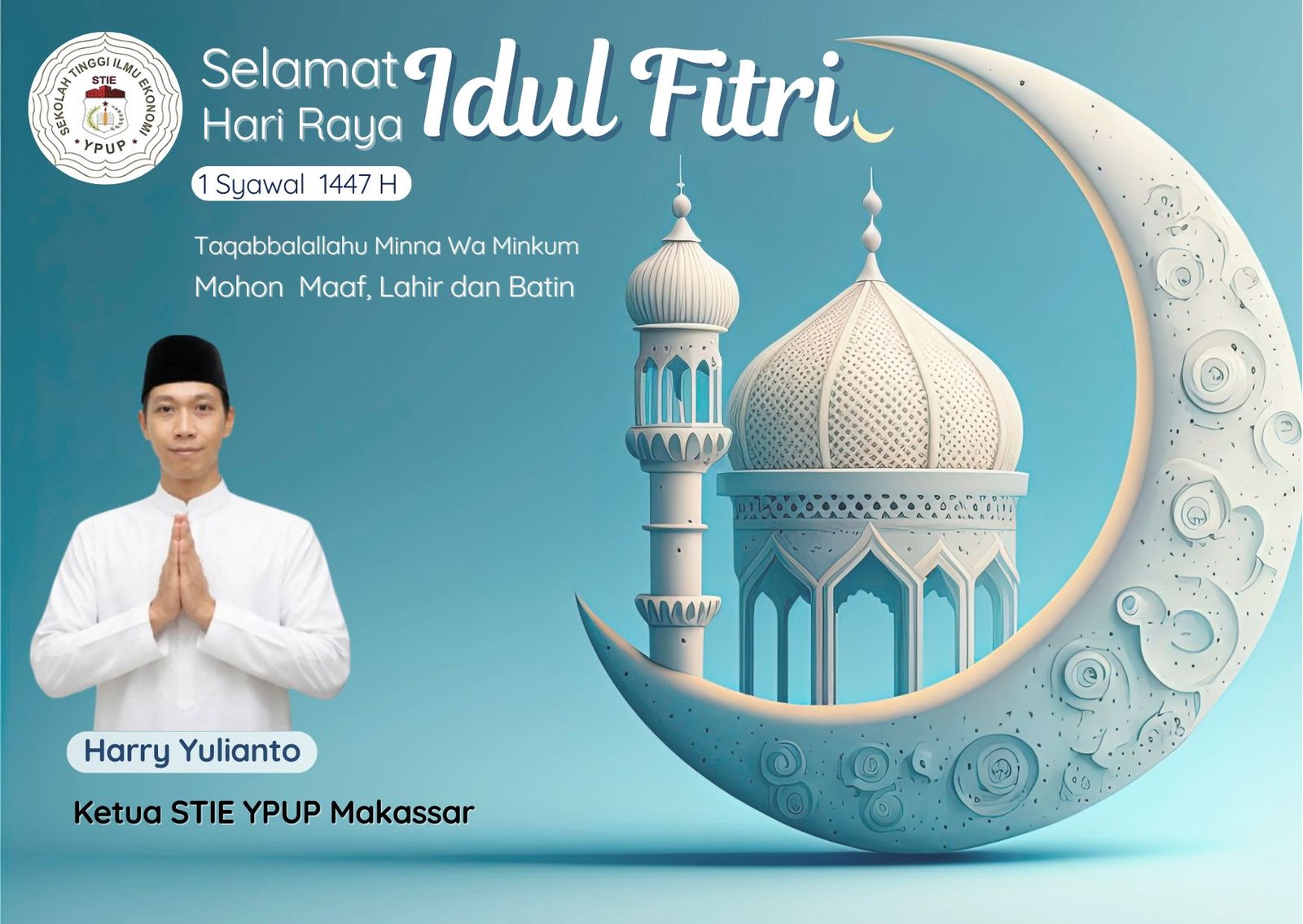
Chairman of STIE YPUP Makassar
Keywords: Academic Integrity, Eid al-Fitr, Plagiarism, Post-Truth.
WIN Media, Opinion – Every year, Muslims in Indonesia celebrate Eid al-Fitr with great joy. The greeting “minal aidin wal faizin” floods social media, sungkeman—the tradition of asking for forgiveness from elders—warms hearts, and the spirit of “victory” after a month of fasting becomes a collective, uplifting energy. But have we ever stopped to ask: to what extent do we truly manifest that victory in real life, especially for those of us immersed in the world of knowledge and scholarship?
For academics—lecturers, researchers, students—true victory is not sufficiently celebrated with beautiful words or WhatsApp statuses. It must be proven through academic integrity: honesty in research, rejection of plagiarism, and the courage to speak truth in the face of pressure. Ironically, amidst the glittering euphoria of Lebaran, the academic world remains confronted by an integrity crisis that shows no signs of abating.
Between Rhetoric of Victory and Reality on Campus
Ramadan teaches Muslims to restrain their desires—including the desire to pursue academic recognition through dishonest means. In this context, Eid al-Fitr should be a moment of “returning to one’s pure nature” (fitrah), where academics reflect on their role as seekers of truth, not merely seekers of legitimacy or positions.
Yet reality tells a different story. Research conducted by Komara (2023) shows that plagiarism among students and lecturers in Indonesia remains a serious issue, with the pressure to publish work quickly identified as a primary trigger. Furthermore, Fatimah (2024), in her study on academic ethics in higher education, found that weak sanctions against integrity violators create a permissive culture that endangers the credibility of the academic world.
Imagine a lecturer who, instead of setting an example, turns a blind eye to contract cheating because they “don’t want the hassle.” Or a researcher who manipulates data so that their findings align with a client’s wishes or particular political interests. Or a student who buys their thesis and a supervisor who looks the other way. Isn’t this a form of “false victory”? Winning in worldly matters—degrees, positions, projects—but losing when it comes to integrity.
Academic Integrity as the True Embodiment of “Fitrah”
Conceptually, academic integrity encompasses honesty in research methodology, data transparency, respect for the intellectual work of others, trustworthiness in teaching, and the courage to voice truth without interference from vested interests (Macfarlane, Zhang, & Pun, 2021). Within the framework of Eid al-Fitr, all these values align with the meaning of “returning to purity”—hearts cleansed of manipulative intentions, hands cleansed of dishonest practices, and tongues cleansed of misinformation.
Unfortunately, integrity often becomes the first casualty in a system that increasingly rewards quantity over quality. Sari and Hidayat (2023) reveal that the publish or perish culture in Indonesia encourages lecturers and researchers to take shortcuts, including committing plagiarism or even using predatory journals. Yet society places great trust in academics as the gatekeepers of truth. When academics lose their integrity, it’s not just individuals who suffer—public confidence in educational institutions is undermined as well.
Challenges in the Post-Truth Era
In the post-truth era, where emotions and personal beliefs often carry more weight than objective facts, the role of academics becomes increasingly crucial. But herein lies the greatest challenge. Election years, for example, become a precarious period when academics are frequently faced with tempting offers: serving as high-paying expert sources, or even occupying strategic positions. The question is: do they remain grounded in scholarly ethics, or do they instead become “opinion mercenaries” defending particular interests?
Adnan (2024), in his study on the role of academics in Indonesia’s political contestation, notes that a growing number of academics become trapped in conflicts of interest, abandoning scientific objectivity for practical gain. Ironically, this often occurs precisely after the Lebaran period, when the spirit of “mutual forgiveness” is misinterpreted as justifying repeated transgressions. Forgiveness is indeed noble, but without genuine behavioral change, it remains an empty annual ritual.
From Rhetoric to Real Action
It is time to stop the habit of treating Lebaran’s “victory” as mere seasonal rhetoric. For lecturers: start the new semester with a commitment to no longer tolerate academic dishonesty. For researchers: publish your work honestly, even if the results do not “please” your funders. For students: make Lebaran a moment to find the courage to say no to contract cheating and other dishonest practices. And for university leaders: impose firm sanctions on integrity violators, not just symbolic reprimands.
Lebaran’s victory is not merely an annual tradition celebrated with ketupat and opor chicken. It is a call to prove that we have truly “triumphed” over our base desires—including the urge to cheat, manipulate, and betray the sacred trust of scholarship.
Let us make our classrooms, laboratories, and academic journals the proving grounds that our victory is more than mere rhetoric. For ultimately, true victory lies in our ability to return to our pure nature as honest, trustworthy, and consistent individuals—both during Ramadan and throughout the other eleven months of the year. Wallahu a’lam bish-shawab (God knows best).