

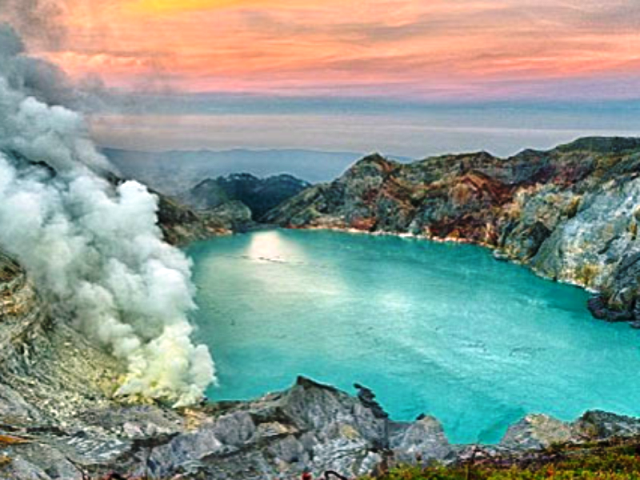
WIN Media, Banyuwangi, 15/2/2026 – At the summit of Mount Ijen, a geological marvel lies hidden, blending mesmerizing beauty and deadly danger into one entity. Ijen Crater Lake, with its turquoise-blue waters reminiscent of a tropical paradise, holds a dark secret: it is the world’s largest acidic lake, with an acidity level capable of dissolving metal and threatening life around it.
This contradictory phenomenon makes Kawah Ijen a destination that never lacks attention from global tourists. However, behind every stunning camera shot lies a stern warning about nature’s power that should never be underestimated.
Born from Ancient Catastrophe
According to records from the Ministry of Energy and Mineral Resources, the Ijen crater lake was formed by a massive eruption of Mount Ijen approximately 3,500 years ago. The eruption, which occurred in three periods, tore apart the mountain’s body and formed a giant caldera with a diameter reaching 25 kilometers. Within this caldera, rainwater and volcanic gases accumulated over thousands of years, creating a lake with a surface area of approximately 41 x 10⁶ m² and a volume reaching 36 x 10⁶ m³.
Didik B. Saputro, a tourism observer from Banyuwangi, explains how the local community views this phenomenon. “The Osing community at the foot of Ijen has understood this mountain’s character for generations. They have a saying: ‘Ijen iku kaya wong wuta kang gagah prakosa’ — Ijen is like a mighty blind person. Beautiful but unpredictable,” he said.
Water More Acidic Than Car Battery
What makes this lake extraordinary is its acidity level. Scientific measurements show the pH of Ijen crater lake water ranges from less than 0.3 to 0.5, making it one of the most acidic bodies of water on Earth.
For comparison, lemon juice has a pH of 2, and car battery acid has a pH of about 1. This means the lake water is far more corrosive than battery acid used in motor vehicles.
The European Space Agency (ESA), through Copernicus Sentinel-2 satellite imagery, confirms that this lake water contains high concentrations of sulfuric acid and hydrochloric acid, as well as various dissolved minerals that give it the characteristic turquoise-green color.
Didik adds a local perspective on this phenomenon. “That turquoise color, for us, is not merely beauty. Sulfur miners call it ‘the guardian’s color.’ They believe the color indicates that the crater is guarded by a force that shouldn’t be disturbed carelessly. Scientifically, yes—the color comes from highly dangerous acid and mineral content,” he explained.
A Poisonous Natural Laboratory
Geochemical research reveals that Ijen crater lake water contains concentrated solutions of various hazardous elements: sulfate around 70,000 mg/kg, chloride 21,000 mg/kg, fluoride 1,500 mg/kg, aluminum 5,000 mg/kg, and iron 2,000 mg/kg, along with significant amounts of heavy metals such as copper, zinc, and lead.
The lake water temperature ranges between 37°C and 45°C, creating conditions that prevent aquatic life from developing. Total Dissolved Solids (TDS) reaches 105 grams per liter, far above normal water thresholds.
Deadly Impacts Flowing Downstream
The acidic water from Ijen Crater does not merely remain at the summit. It seeps through the crater walls and forms a river called Banyupahit River (Bitter Water River) that flows down to residential areas.
Along its course, this river water has a pH between 2.5 and 3.5—still far below the normal standard for river water, which ranges from 6 to 8. Despite its toxicity, farmers still use this water to irrigate their agricultural land due to the scarcity of alternative water sources.
Didik highlights this irony. “This is what we call both blessing and curse. Farmers downstream are forced to use Banyupahit water for their rice fields. As a result, the land becomes more acidic, productivity decreases, and they must use large amounts of agricultural lime to neutralize the soil. But they have no other choice,” he revealed.
Blue Fire: An Inseparable Companion
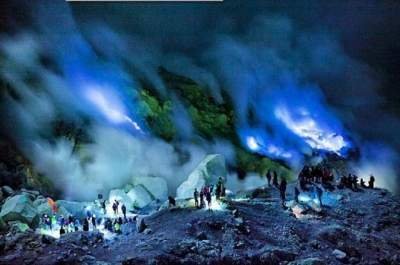
Besides its acidic lake, Kawah Ijen is also famous for the rare blue fire phenomenon. When sulfur gases at temperatures above 360°C emerge from fumarole cracks and meet oxygen, they ignite with an electric blue flame only clearly visible at night.
This phenomenon makes Ijen one of only two places in the world (besides Ethiopia) where blue fire can be witnessed naturally. The same gases also produce pure sulfur deposits that become a livelihood source for traditional miners.
Safety Above Beauty
For tourists wishing to witness this wonder, caution is absolutely necessary. Toxic gases around the crater—especially sulfur dioxide—can cause respiratory irritation, eye inflammation, and even death in high concentrations.
Didik reminds visitors to respect nature. “Every year there are tourists who faint or experience shortness of breath because they underestimate the toxic gases. They’re too focused on getting a good photo, forgetting they’re standing on the edge of the world’s most acidic crater. Use gas masks, follow guide instructions, and never approach the fumaroles,” he emphasized.
Sustainable Tourism Amidst Danger
Kawah Ijen is now managed as part of the Ijen UNESCO Global Geopark, with various educational and conservation programs. Local government and tourism managers continuously strive to balance tourism promotion with visitor safety and environmental preservation.
“We want tourists to return not only with beautiful photos but also with understanding that this nature must be protected. Kawah Ijen is a giant laboratory teaching us about Earth’s power. It is beautiful, but it does not tolerate mistakes,” concluded Didik.
As a closing note, he shares a wise message: “Enjoy the turquoise beauty from a distance. Respect the boundaries that have been set. Because in this place, beauty and death coexist in silence.”
At the summit of Mount Ijen, a geological marvel lies hidden, blending mesmerizing beauty and deadly danger into one entity. Ijen Crater Lake, with its turquoise-blue waters reminiscent of a tropical paradise, holds a dark secret: it is the world’s largest acidic lake, with an acidity level capable of dissolving metal and threatening life around it.
This contradictory phenomenon makes Kawah Ijen a destination that never lacks attention from global tourists. However, behind every stunning camera shot lies a stern warning about nature’s power that should never be underestimated.
Born from Ancient Catastrophe
According to records from the Ministry of Energy and Mineral Resources, the Ijen crater lake was formed by a massive eruption of Mount Ijen approximately 3,500 years ago. The eruption, which occurred in three periods, tore apart the mountain’s body and formed a giant caldera with a diameter reaching 25 kilometers. Within this caldera, rainwater and volcanic gases accumulated over thousands of years, creating a lake with a surface area of approximately 41 x 10⁶ m² and a volume reaching 36 x 10⁶ m³.
Didik B. Saputro, a tourism observer from Banyuwangi, explains how the local community views this phenomenon. “The Osing community at the foot of Ijen has understood this mountain’s character for generations. They have a saying: ‘Ijen iku kaya wong wuta kang gagah prakosa’ — Ijen is like a mighty blind person. Beautiful but unpredictable,” he said.
Water More Acidic Than Car Battery
What makes this lake extraordinary is its acidity level. Scientific measurements show the pH of Ijen crater lake water ranges from less than 0.3 to 0.5, making it one of the most acidic bodies of water on Earth.
For comparison, lemon juice has a pH of 2, and car battery acid has a pH of about 1. This means the lake water is far more corrosive than battery acid used in motor vehicles.
The European Space Agency (ESA), through Copernicus Sentinel-2 satellite imagery, confirms that this lake water contains high concentrations of sulfuric acid and hydrochloric acid, as well as various dissolved minerals that give it the characteristic turquoise-green color.
Didik adds a local perspective on this phenomenon. “That turquoise color, for us, is not merely beauty. Sulfur miners call it ‘the guardian’s color.’ They believe the color indicates that the crater is guarded by a force that shouldn’t be disturbed carelessly. Scientifically, yes—the color comes from highly dangerous acid and mineral content,” he explained.
A Poisonous Natural Laboratory
Geochemical research reveals that Ijen crater lake water contains concentrated solutions of various hazardous elements: sulfate around 70,000 mg/kg, chloride 21,000 mg/kg, fluoride 1,500 mg/kg, aluminum 5,000 mg/kg, and iron 2,000 mg/kg, along with significant amounts of heavy metals such as copper, zinc, and lead.
The lake water temperature ranges between 37°C and 45°C, creating conditions that prevent aquatic life from developing. Total Dissolved Solids (TDS) reaches 105 grams per liter, far above normal water thresholds.
Deadly Impacts Flowing Downstream
The acidic water from Ijen Crater does not merely remain at the summit. It seeps through the crater walls and forms a river called Banyupahit River (Bitter Water River) that flows down to residential areas.
Along its course, this river water has a pH between 2.5 and 3.5—still far below the normal standard for river water, which ranges from 6 to 8. Despite its toxicity, farmers still use this water to irrigate their agricultural land due to the scarcity of alternative water sources.
Didik highlights this irony. “This is what we call both blessing and curse. Farmers downstream are forced to use Banyupahit water for their rice fields. As a result, the land becomes more acidic, productivity decreases, and they must use large amounts of agricultural lime to neutralize the soil. But they have no other choice,” he revealed.
Blue Fire: An Inseparable Companion
Besides its acidic lake, Kawah Ijen is also famous for the rare blue fire phenomenon. When sulfur gases at temperatures above 360°C emerge from fumarole cracks and meet oxygen, they ignite with an electric blue flame only clearly visible at night.
This phenomenon makes Ijen one of only two places in the world (besides Ethiopia) where blue fire can be witnessed naturally. The same gases also produce pure sulfur deposits that become a livelihood source for traditional miners.
Safety Above Beauty
For tourists wishing to witness this wonder, caution is absolutely necessary. Toxic gases around the crater—especially sulfur dioxide—can cause respiratory irritation, eye inflammation, and even death in high concentrations.
Didik reminds visitors to respect nature. “Every year there are tourists who faint or experience shortness of breath because they underestimate the toxic gases. They’re too focused on getting a good photo, forgetting they’re standing on the edge of the world’s most acidic crater. Use gas masks, follow guide instructions, and never approach the fumaroles,” he emphasized.
Sustainable Tourism Amidst Danger
Kawah Ijen is now managed as part of the Ijen UNESCO Global Geopark, with various educational and conservation programs. Local government and tourism managers continuously strive to balance tourism promotion with visitor safety and environmental preservation.
“We want tourists to return not only with beautiful photos but also with understanding that this nature must be protected. Kawah Ijen is a giant laboratory teaching us about Earth’s power. It is beautiful, but it does not tolerate mistakes,” concluded Didik.
As a closing note, he shares a wise message: “Enjoy the turquoise beauty from a distance. Respect the boundaries that have been set. Because in this place, beauty and death coexist in silence.”
Safe Visiting Tips for Kawah Ijen:
- Use gas masks or specialized respirators, not just wet cloths
- Hire official guides who understand the terrain and danger signs
- Start the trek early morning (around 01:00-02:00 AM local time) to see the blue fire
- Maintain safe distance from fumaroles and the crater edge
- Obey all warnings and prohibitions from officials
Danau Asam Terbesar Di Dunia Di Puncak Ijen: Keindahan Biru Toska Yang Mematikan
WIN Media, Banyuwangi, 15/2/2026 – Di puncak Gunung Ijen, tersembunyi sebuah keajaiban geologi yang memadukan keindahan memesona dan bahaya mematikan dalam satu kesatuan. Danau Kawah Ijen, dengan airnya yang berwarna biru toska bak surga tropis, menyimpan rahasia kelam: ia adalah danau asam terbesar di dunia, dengan tingkat keasaman yang mampu melarutkan logam dan mengancam kehidupan di sekitarnya.
Fenomena kontradiktif ini menjadikan Kawah Ijen sebagai destinasi yang tak pernah sepi dari perhatian wisatawan dunia. Namun, di balik setiap jepretan kamera yang mengagumkan, tersimpan peringatan keras akan kekuatan alam yang tak boleh diremehkan.
Lahir dari Bencana Purba
Menurut catatan Kementerian Energi dan Sumber Daya Mineral, danau kawah Ijen terbentuk akibat letusan dahsyat Gunung Ijen sekitar 3.500 tahun silam. Letusan yang terjadi dalam tiga periode tersebut merobek tubuh gunung dan membentuk kaldera raksasa dengan diameter mencapai 25 kilometer. Di dalam kaldera itulah, air hujan dan gas vulkanik terakumulasi selama ribuan tahun, menciptakan danau dengan luas permukaan sekitar 41 x 10⁶ m² dan volume mencapai 36 x 10⁶ m³.
Didik B. Saputro, pengamat wisata dari Banyuwangi, menjelaskan bagaimana masyarakat setempat memandang fenomena ini. “Masyarakat Osing di kaki Ijen sudah turun-temurun memahami karakter gunung ini. Mereka punya pepatah: ‘Ijen iku kaya wong wuta kang gagah prakosa’ — Ijen itu seperti orang buta yang gagah perkasa. Indah tapi tak bisa ditebak,” ujarnya.
Air Lebih Asam dari Aki Motor
Yang membuat danau ini luar biasa adalah tingkat keasamannya. Pengukuran ilmiah menunjukkan pH air danau Kawah Ijen berada di kisaran kurang dari 0,3 hingga 0,5, menjadikannya salah satu perairan paling asam di Bumi.
Sebagai perbandingan, air lemon memiliki pH 2, dan cairan aki motor memiliki pH sekitar 1. Artinya, air danau ini jauh lebih korosif dibandingkan cairan aki yang digunakan dalam kendaraan bermotor.
Badan Antariksa Eropa (ESA) melalui citra satelit Copernicus Sentinel-2 mengonfirmasi bahwa air danau ini mengandung konsentrasi tinggi asam sulfat dan asam klorida, serta berbagai mineral terlarut yang memberikan warna biru kehijauan yang khas.
Didik menambahkan perspektif lokal tentang fenomena ini. “Warna biru toska itu bagi kami bukan sekadar keindahan. Para penambang belerang menyebutnya ‘warna penjaga’. Mereka percaya warna itu adalah tanda bahwa kawah dijaga oleh kekuatan yang tidak boleh diganggu sembarangan. Secara ilmiah, ya benar—warna itu dari kandungan asam dan mineral yang sangat berbahaya,” jelasnya.
Laboratorium Alam Beracun
Penelitian geokimia mengungkapkan bahwa air danau Kawah Ijen mengandung larutan pekat berbagai unsur berbahaya: sulfat sekitar 70.000 mg/kg, klorida 21.000 mg/kg, fluor 1.500 mg/kg, aluminium 5.000 mg/kg, dan besi 2.000 mg/kg, serta logam berat seperti tembaga, seng, dan timbal dalam jumlah signifikan.
Suhu air danau berkisar antara 37°C hingga 45°C, menciptakan kondisi yang tidak memungkinkan kehidupan akuatik berkembang. Total padatan terlarut (TDS) mencapai 105 gram per liter, jauh di atas ambang batas air normal.
Dampak Mematikan yang Mengalir ke Hilir
Air asam dari Kawah Ijen tidak hanya diam di puncak. Ia merembes melalui dinding kawah dan membentuk aliran sungai bernama Kali Banyupahit (Sungai Air Pahit) yang mengalir hingga ke pemukiman penduduk.
Sepanjang alirannya, air sungai ini memiliki pH antara 2,5 hingga 3,5—masih jauh di bawah standar normal air sungai yang berkisar antara 6 hingga 8. Meski beracun, air ini tetap digunakan petani untuk mengairi lahan pertanian mereka karena keterbatasan sumber air lain.
Didik menyoroti ironi ini. “Inilah yang disebut berkah sekaligus kutukan. Petani di bawah terpaksa menggunakan air Banyupahit untuk sawah mereka. Hasilnya, lahan menjadi lebih asam, produktivitas menurun, dan mereka harus menggunakan kapur pertanian dalam jumlah besar untuk menetralkan tanah. Tapi mereka tidak punya pilihan lain,” ungkapnya.
Fenomena Blue Fire: Pasangan yang Tak Terpisahkan
Selain danau asamnya, Kawah Ijen juga terkenal dengan fenomena api biru (blue fire) yang langka. Ketika gas belerang bersuhu di atas 360°C keluar dari celah-celah fumarola dan bertemu oksigen, ia terbakar dengan nyala biru elektrik yang hanya terlihat jelas pada malam hari.
Fenomena ini menjadikan Ijen sebagai salah satu dari hanya dua tempat di dunia (selain di Ethiopia) di mana api biru dapat disaksikan secara alami. Gas yang sama juga menghasilkan endapan belerang murni yang menjadi sumber penghidupan para penambang tradisional.
Keselamatan di Atas Keindahan
Bagi wisatawan yang ingin menyaksikan keajaiban ini, kewaspadaan mutlak diperlukan. Gas beracun di sekitar kawah—terutama sulfur dioksida—dapat menyebabkan iritasi saluran pernapasan, radang mata, bahkan kematian dalam konsentrasi tinggi.
Didik mengingatkan para pendatang untuk menghormati alam. “Setiap tahun selalu ada wisatawan yang pingsan atau mengalami sesak napas karena meremehkan gas beracun. Mereka terlalu fokus mencari foto bagus, lupa bahwa mereka sedang berdiri di tepi kawah paling asam di dunia. Gunakan masker gas, ikuti arahan pemandu, dan jangan pernah mendekati fumarola,” tegasnya.
Pariwisata Berkelanjutan di Tengah Bahaya
Kawah Ijen kini dikelola sebagai bagian dari Ijen UNESCO Global Geopark, dengan berbagai program edukasi dan konservasi. Pemerintah daerah bersama pengelola wisata terus berupaya menyeimbangkan antara promosi pariwisata dan keselamatan pengunjung, serta menjaga kelestarian lingkungan.
“Kami ingin wisatawan pulang bukan hanya dengan foto indah, tapi juga pemahaman bahwa alam ini harus dijaga. Kawah Ijen adalah laboratorium raksasa yang mengajarkan kita tentang kekuatan bumi. Ia cantik, tapi ia tidak bersahabat dengan kesalahan,” pungkas Didik.
Sebagai penutup, ia menyampaikan pesan bijak: “Nikmati keindahan biru toska dari kejauhan. Hormati batas-batas yang telah ditentukan. Karena di tempat ini, keindahan dan maut hidup berdampingan dalam diam.”
Tips Aman Berkunjung ke Kawah Ijen:
Gunakan masker gas atau respirator khusus, jangan hanya kain basah
- Sewa pemandu resmi yang memahami medan dan tanda-tanda bahaya
- Mulai pendakian dini hari (sekitar pukul 01.00-02.00 WIB) untuk melihat blue fire
- Jaga jarak aman dari fumarola dan bibir kawah
- Patuhi semua peringatan dan larangan dari petugas